Kanban for AI agents.
A board is only worth having if an agent cannot mark its own work done. Here the card belongs to a coordinator: /crew asks what is missing once, opens the card, and closes it only when its proof command exited 0. One ask in, a verified card out.
›/crew add Stripe checkout for the Pro plan, in test mode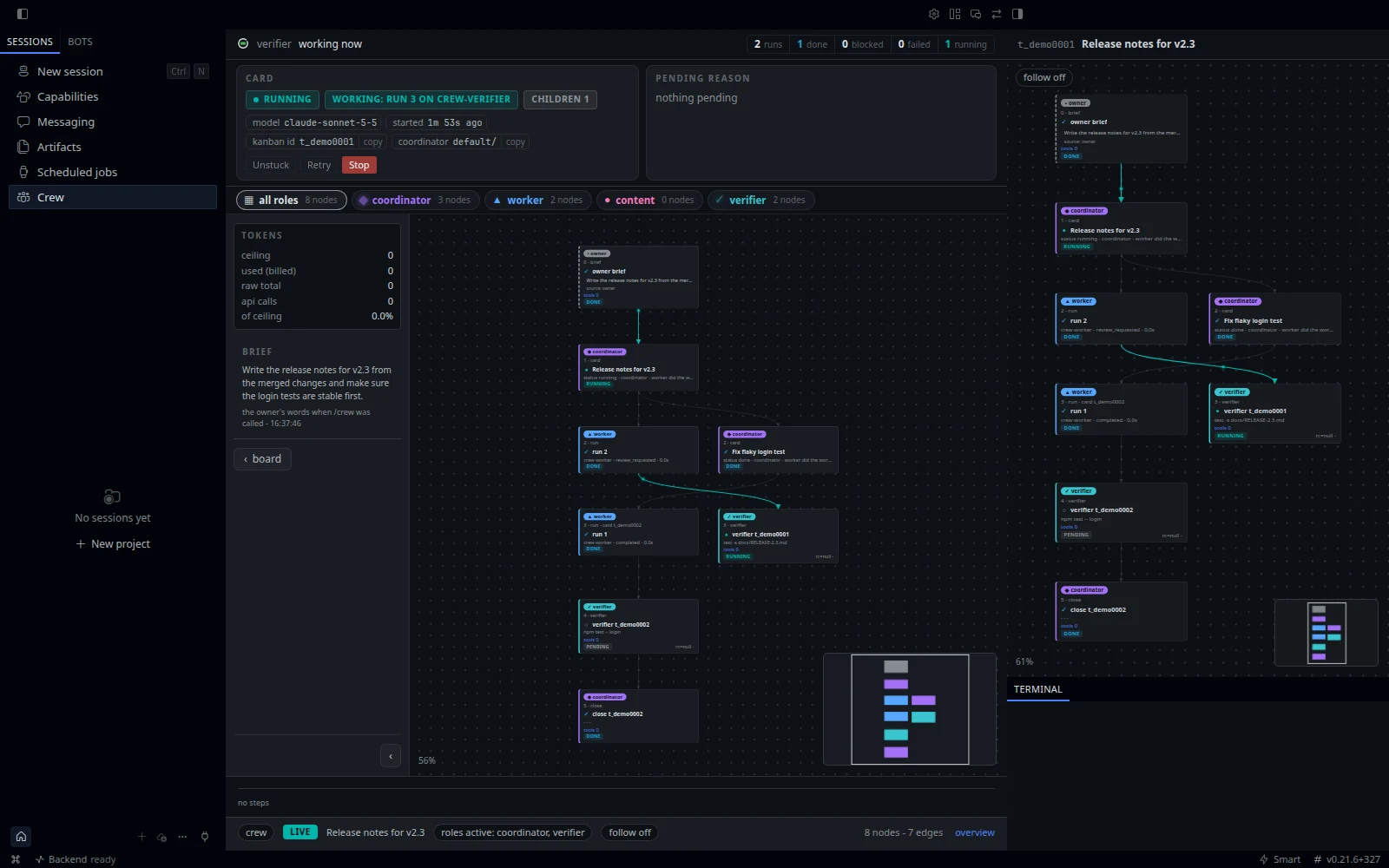
Cards move on their own. You are asked only where a decision is owed, and a card that has no proof has not moved.
An agent that grades its own work says done.
A card with no external check is a promise, not a state. The model that wrote the code is the last thing that should decide whether the code works.
Six parallel cards fork the plan.
Two cards touch the same file, each one confident, and nobody owns the conflict. The board looks busy and the branch stops making sense.
Every stop becomes a question to you.
If the agent asks a human whenever it hesitates, the board is a mailbox and the work waits for someone to read it.
What the best kanban for AI agents has to do.
Four checks to apply before a board touches real work. This one is built around all four, and the sections after this show each of them doing its job.
- A named proof, per cardNot “tests pass” in prose: a command whose exit code decides whether the card moves. It is written when the card opens and used unchanged at the end.
- A coordinator that decidesOne role wakes on every card event with the record in hand and takes one bounded decision: fix it, shrink the scope, split the card, or ask you one question.
- The board on your machineIt runs inside your Hermes profile against your repository. There is no hosted board, no upload, and no account in the middle.
- A stop you can affordEvery run ends at its token budget and says so. A card that stops is not a card that failed; it is a card that did not get to spend your night.
Seven stations. You stand at both ends.
Each station is a role with its own profile, model and tools. The two that decide whether work is done run no model at all, which is the whole reason they can be trusted with the question.
One message, and how you would know it is done.
Asks once for what is missing, opens the card, ends the turn.
Every card event, one bounded turn, one decision.
One writer per card, inside the contract's scope.
The command runs in a tool. 0 is the only pass.
The coordinator re-runs the proof before the card can close.
One line in your thread, or one question after two tries.
What happens between the ask and the board.
Take the ask in the box at the top of this page: add Stripe checkout for the Pro plan, in test mode. It is one sentence, and it hides six jobs.
- 01 · The contractFive questions in one batch: test keys or live, which plan ids, what a passing payment looks like. Then the contract is written and the card opens. You answered once.
- 02 · The fan-outThe coordinator splits the work: the checkout session, the webhook handler, the price lookup, the test that drives a card payment, the docs, the cleanup. One writer owns each card.
- 03 · The stopsA card that cannot proceed does not wait for you. It gets one decision: fix, shrink, split, or one concrete question, and only that last one reaches your chat.
- 04 · The endA card closes when its proof exits 0 and the coordinator has re-run it. One line per card comes back, and the card page keeps the graph, the transcript and the command that decided it.
A proof is a command, not a promise.
The sentence you use to say how you would know it is done becomes a shell command, frozen when the card opens. No model sits in that step, so there is nothing to talk into a pass.
›pytest -q tests/test_checkout.py›npm run build›curl -fsS http://127.0.0.1:8799/healthThe first fails on a failing test even if the new one passes, because the command names the file. The second fails on a type error or a broken bundle. The third is for a card about the dashboard: the proof is that the service answers on 127.0.0.1:8799, not that the code compiles. Unattended proofs have their own switch, /crew-safety brave|safe, and a card that asks a proof question is answered with /crew-proof <card> yes|brave.
Kanban board for AI agents on GitHub.
The plugin is Apache-2.0 and lives at github.com/macd2/Crew, with issues, pull requests and the whole history. Install is this line plus one setup script, and /crew-status answers whether it is wired.
›hermes plugins install macd2/CrewDoes it replace Hermes’ own kanban?
While Crew is on, Hermes hides its own Kanban row; /crew and the board are the same surface. Nothing else in Hermes changes.
What does it need to run?
Hermes Agent 0.21.5 or newer with the kanban board, and Python 3.11+. The plugin declares requires_hermes: ">=0.21.5", so an older Hermes refuses to load it instead of half-working.
How many cards run at once?
One ask fans out into up to six cards that run side by side. One writer per card, each with its own budget.
How does a card stop?
The worker stops itself after five failed tool calls in a row, a role’s run is capped at 60 steps, and every run ends at its token budget.
Can a card be closed without proof?
No. A card cannot be marked done until its proof command runs without error. That is the rule the whole board is built around.
Which commands are there?
/crew, /crew-status, /crew-stop, /crew-diagnose, /crew-graph, /crew-unstuck, /crew-safety and /crew-proof. The first and the fourth run as skills in your own session; the rest are plugin commands.
Does it run on Windows?
Yes, natively with Git for Windows, because proofs run in Git Bash; there the graph-http service and --nightly-proofs are skipped. Under WSL both are unchanged, as on Linux.
Is the kanban board for AI agents open source?
Yes. The plugin is Apache-2.0 on GitHub, and what you install is the same code: there is no hosted tier holding a feature back.
Install.
Give it an ask.
Install once per profile; running it twice changes nothing. Then type the ask in the chat you already use. The card, and its ending, come back to that thread.
›Set up Hermes.Crew for my Hermes profile NAME: run hermes plugins install macd2/Crew, then python3 ~/.hermes/plugins/crew/install.py --profile NAME and hermes -p NAME plugins doctor crew, and fix anything they report. Finish by sending /crew-status in my chat and tell me what it answered.$hermes plugins install macd2/Crew$python3 ~/.hermes/plugins/crew/install.py --profile NAME$hermes -p NAME plugins doctor crewStar on GitHubFree and open source · Apache-2.0